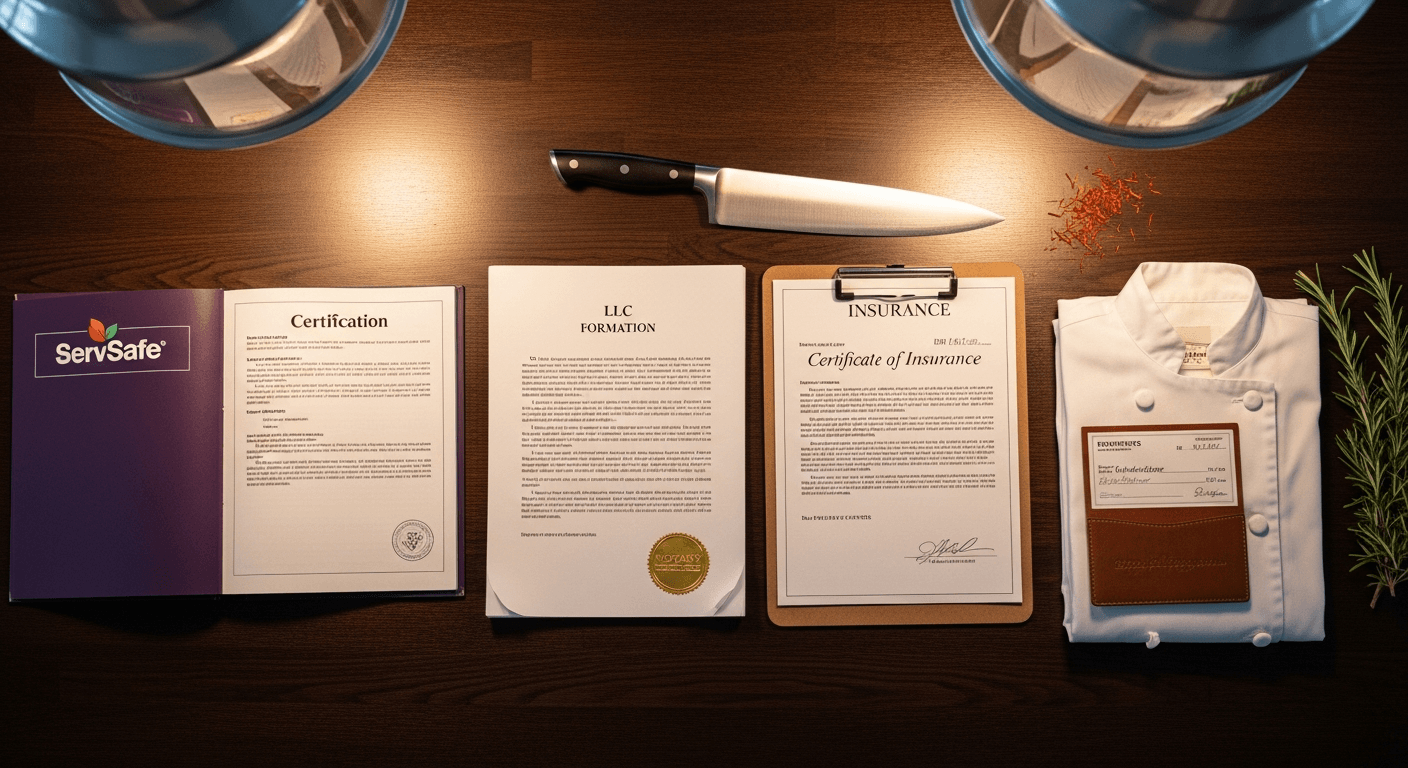
You can cook. People keep saying you should sell it. The bridge between "I should" and "I'm doing it" is paperwork — four certifications, an LLC, a couple of insurance policies, and a payments setup. Most aspiring private chefs stall here because nobody wrote down the order and nobody told them how long each step actually takes. This post does both. Specific to Massachusetts and Rhode Island; the framework applies anywhere.
Suppah Social requires four certifications + an active LLC + a Stripe Connect account before a chef can publish a menu, accept proposals, or get paid. Whether or not you join us, this is the same baseline most serious private chef gigs ask for, and the same baseline an insurance company will ask for if you ever have to file a claim.
Step 1: Food Safety Certification (ServSafe Manager)
The non-negotiable. Every state requires anyone running food service — including a private chef cooking in someone else's home — to hold a current food protection manager certification from an ANSI-accredited program. ServSafe Manager is the most-recognized of these. It's a 10-hour-ish online course followed by a proctored 90-question exam. Pass rate is high if you actually study. Cost: roughly $179. Renewal: every 5 years.
The certification covers temperature danger zones, cross-contamination, allergen awareness at a basic level, food storage, and personal hygiene. Boring. Necessary. The card you get is what you flash if a health department or insurance carrier asks. A lot of catering venues won't let you cook on premises without a copy of yours on file.
Where to do it: servsafe.com — pick "Manager", not the cheaper "Food Handler" tier. Food Handler is for line staff. Manager is what you need.
Step 2: Allergen Awareness
Massachusetts (and several other states) requires a separate allergen awareness certification on top of ServSafe Manager. ServSafe offers an Allergens course for about $25 — short, single-session, easy. Even where it isn't legally required, it's a credential allergic guests will explicitly check for. Worth the hour.
On Suppah Social, every chef profile shows whether they hold the allergen credential. Guests with severe allergies filter for it before even considering booking.
Step 3: Form an LLC
You can take a private chef gig as a sole proprietor — no entity required. But the moment something goes wrong (a guest gets sick, a knife slips, a host's countertop gets damaged), a sole prop means your personal assets are exposed. An LLC creates a legal wall between "the business" and "you." If the business gets sued, the business's assets are at risk; your house and your savings aren't.
Cost varies by state:
- Massachusetts: $500 to file Articles of Organization with the Secretary of the Commonwealth, $500 annual report. Online filing takes about 30 minutes. Bring your business name, registered office address, and a description of activity ("personal chef services / private dining").
- Rhode Island: $150 to file Articles of Organization with the RI Secretary of State, $50 annual report. Cheaper, faster, similar form.
- If you're elsewhere: google "[your state] LLC formation". Most states are between $50 and $500 to file, and another $20–$300 annually.
Skip the "LLC formation services" that charge $300 on top of the state fee — LegalZoom, ZenBusiness, IncFile. The state's own portal does the same job for the actual filing fee. Save the difference.
After your LLC is approved (usually 5–10 business days), get an EIN from irs.gov/ein — free, takes 10 minutes online. The EIN is what you give to your bank, your insurance company, and Stripe Connect.
Step 4: Insurance — Liability + Product
Two policies you actually need:
- General Liability ($1M / $2M). Covers bodily injury and property damage caused by your business operations. A guest slips on a wet floor in the host's kitchen → general liability. You knock over a $3K vase setting up the dining table → general liability. Annual cost: typically $400–$800 for a private chef with no employees.
- Product Liability (often bundled with general). Covers claims arising from food you served — foodborne illness, undisclosed allergen, foreign object. Almost always included in a Business Owners Policy (BOP) for private chefs. Make sure it's in the policy explicitly.
Carriers that work with private chefs: Hiscox, FLIP (Food Liability Insurance Program), Next Insurance, NEXTbite Insurance. FLIP is purpose-built for the private-chef / pop-up / catering segment and will quote you in 10 minutes online — that's a good starting point even if you end up with someone else.
What you'll need ready: your LLC name and EIN, your ServSafe + allergen certifications, an estimate of annual gross revenue, list of services (private dining, meal prep, public events). The policy issues immediately on payment; you get a Certificate of Insurance (COI) PDF you can send to anyone who asks (host venues, platforms, hesitant guests).
On Suppah Social, your COI is part of the four-cert verification — admin reviews it before your menu goes live.
Step 5: Business Bank + Stripe Connect
Open a business checking account in your LLC's name. Almost any bank will do this for free with your EIN + Articles of Organization. Mercury, Relay, Bluevine, and Chase Business Complete are all fine — pick on convenience to where you live.
Then connect that bank to Stripe Connect Express. On Suppah Social, this happens during chef onboarding at /join/chef: identity verification + bank linking happen in a single Stripe-hosted flow that takes about 5 minutes. Once you're Stripe-connected, every booking pays out to your LLC's account automatically; the platform takes 5%, you keep 95% on private dining and meal prep, and 70% on ticketed events with a host space.
The Order It Actually Goes In
Don't try to do all five at once. The order that minimizes wasted weeks:
- Week 1: ServSafe Manager + Allergen courses + exams. (~$200, ~12 hours of your time.)
- Week 1–2: File LLC online while waiting on ServSafe results. ($150–$500, 30 min to file.)
- Week 2–3: EIN from IRS once LLC is approved. (Free, 10 min online.)
- Week 3: Buy general liability + product liability via FLIP or Hiscox. ($400–$800/year, 10 min to apply.)
- Week 3: Open business bank account. (Free, 30 min in person or online.)
- Week 3–4: Stripe Connect onboarding via your platform of choice (Suppah Social, your own website, etc.). (Free, 5 min.)
Total time: about a month from "I should do this" to "I can legally and safely take a paid private-chef gig." Total cash: $750–$1500 depending on state and insurance carrier. Annual recurring after that: $500–$1300 (LLC annual report + insurance renewal).
What Suppah Social Asks For
Specifically: ServSafe Manager (or equivalent ANSI-accredited food protection cert), an allergen certification, an active business license / LLC, and a current Certificate of Insurance for general + product liability. All four upload to your chef profile during /join/chef; admin reviews each one and approves it (usually inside 24h).
You can land in the app and start drafting menus with just one approved cert. The full four are required to publish public events, accept proposals, or activate a meal-prep menu — everything a paying member can find. We chose that threshold so chefs aren't blocked from setting up their workspace while certs land in the queue, but only fully-credentialed chefs are visible to guests.
Read the full chef onboarding flow at /for-chefs. Or jump straight to the application: /join/chef.
Liked this? Send it to a friend.